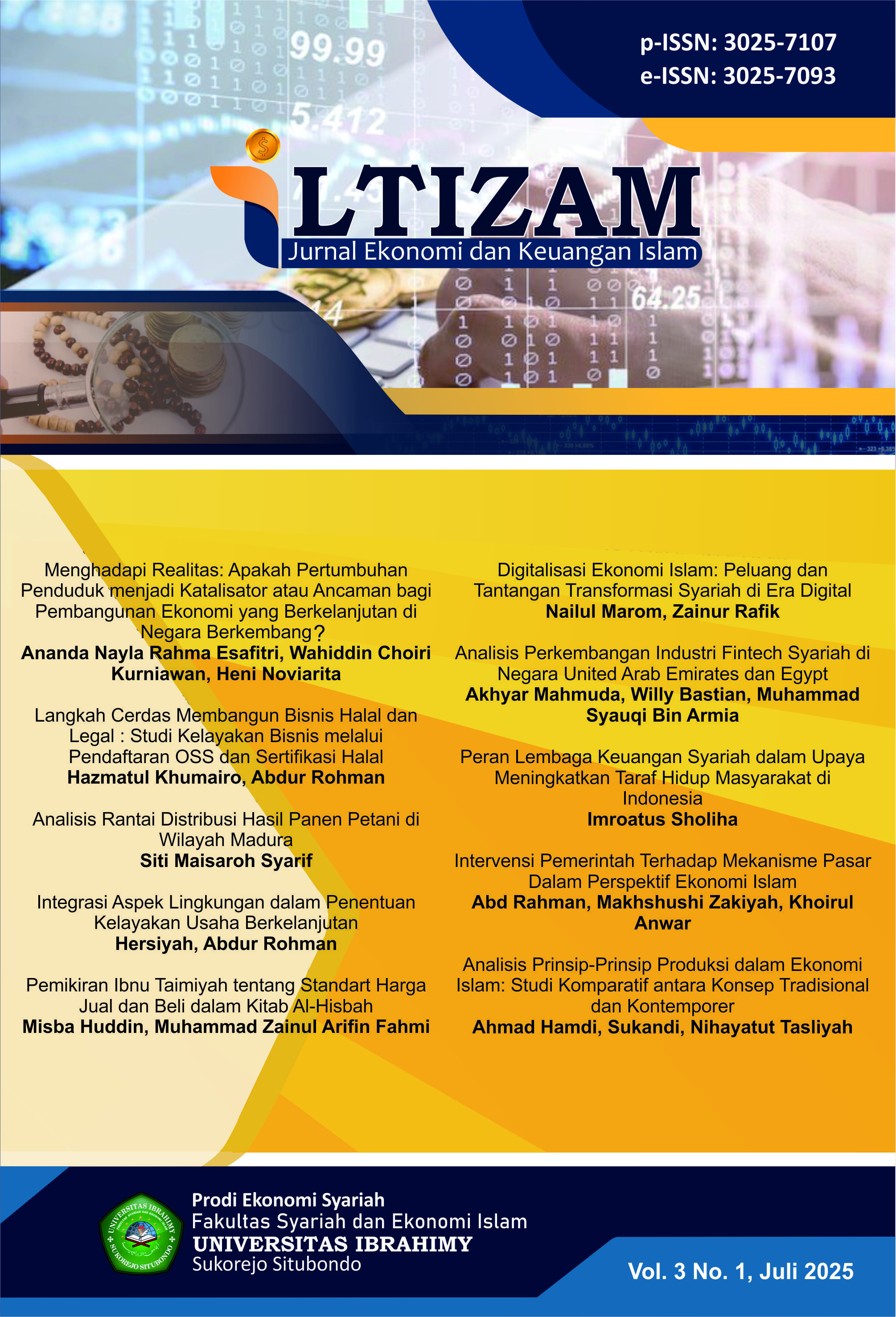
ANALISIS PRINSIP-PRINSIP PRODUKSI DALAM EKONOMI ISLAM: STUDI KOMPARATIF ANTARA KONSEP TRADISIONAL DAN KONTEMPORER
DOI:
https://doi.org/10.35316/iltizam.v3i1.7877Keywords:
Islamic Production, Traditional Economics, Contemporary ApproachAbstract
This study aims to analyze and compare the principles of production in Islamic economics from both traditional and contemporary perspectives. In Islamic economics, production is not merely an economic activity but also a form of worship encompassing moral, social, and spiritual dimensions. The traditional approach is grounded in the thoughts of classical scholars such as Al-Ghazali, Ibn Khaldun, and Al-Mawardi, who emphasized the importance of maqāṣid al-sharī‘ah in guiding production activities. Production is viewed as a means to promote public welfare, uphold justice, and prevent social and environmental harm. Meanwhile, the contemporary approach emerges in response to globalization and economic modernization. Contemporary scholars like M. Umer Chapra and M. Nejatullah Siddiqi attempt to integrate Islamic values with modern economic principles that emphasize sustainability and justice. In this context, Islamic production extends beyond the concepts of halal and thayyib to include social responsibility, environmental conservation, gender inclusion, and digital transformation. This research employs a qualitative methodology using library research, exploring both classical and modern literature to identify continuities and differences between the two approaches. The findings indicate that while methodological and contextual differences exist, both perspectives share foundational values. A synergy between traditional and contemporary views is deemed essential to establish a production system that is both normatively grounded and contextually relevant. Thus, Islamic economic thought remains dynamic and adaptive, rooted in transcendental values yet open to reform grounded in maqāṣid al-sharī‘ah.
Downloads
Published
Issue
Section
License
Copyright (c) 2025 Ahmad Hamdi, Sukandi Sukandi, Nihayatut Tasliyah

This work is licensed under a Creative Commons Attribution 4.0 International License.