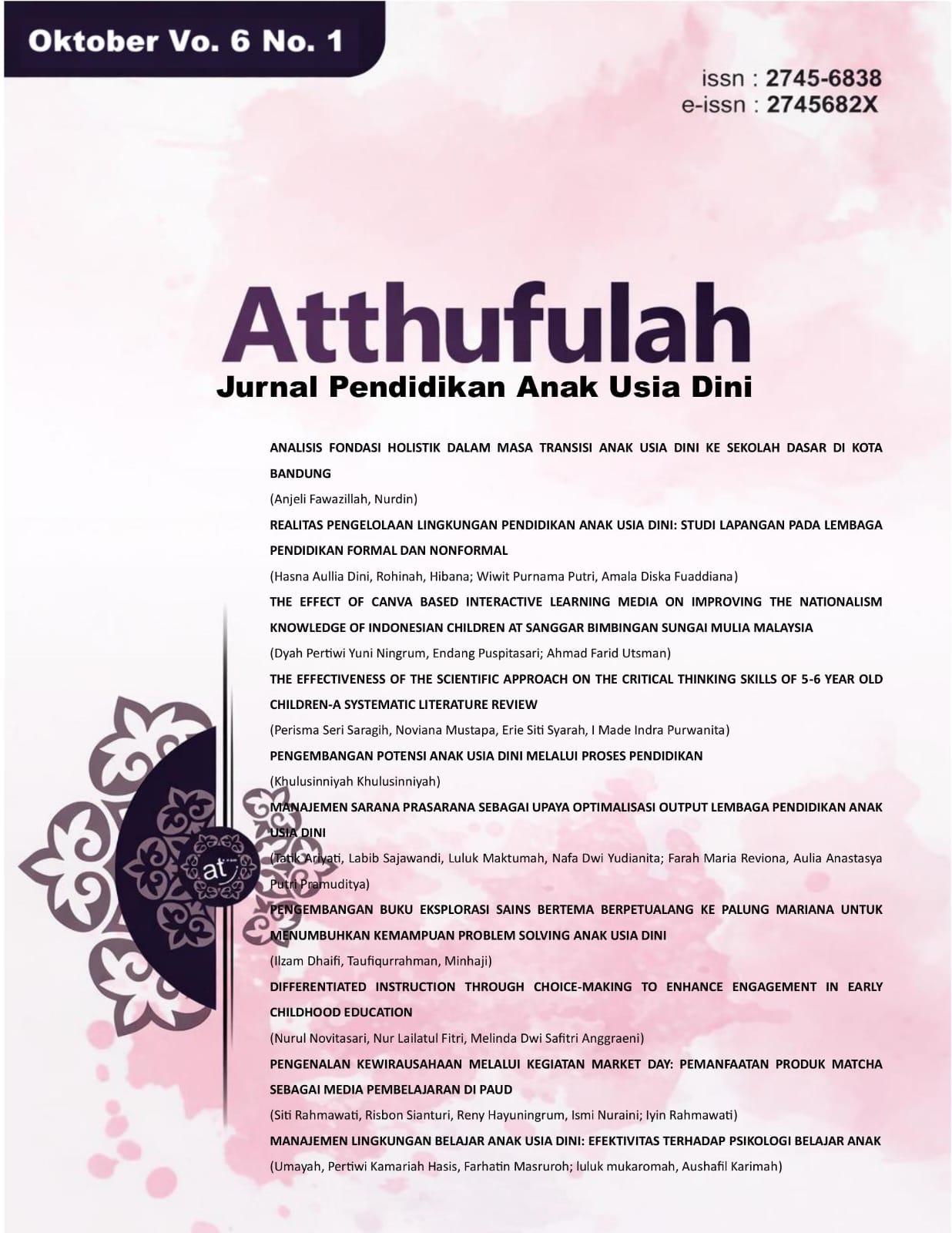
PENGEMBANGAN BUKU EKSPLORASI SAINS BERTEMA BERPETUALANG KE PALUNG MARIANA UNTUK MENUMBUHKAN KEMAMPUAN PROBLEM SOLVING ANAK USIA DINI
Keywords:
digital media, problem-solving ability, early childhood, interactive learningAbstract
Problem-solving ability is an essential aspect of early childhood cognitive development, as it shapes logical, critical, and creative thinking from an early age. However, many early childhood learning practices still focus on rote activities that do not sufficiently stimulate higher-order thinking skills. This study aims to analyze the effect of digital learning media on improving problem-solving abilities among early childhood students. The research employed a quasi-experimental design with a one-group pretest-posttest model involving 32 children in group B at an early childhood education institution in Situbondo. Data were collected through observation sheets assessing children’s problem-solving abilities and analyzed using simple linear regression. The results indicate a positive and significant influence between the use of digital media and children’s problem-solving ability (r = 0.61; p < 0.05) with the regression equation Y = 14.86 + 0.40X. The coefficient of determination (R²) value of 0.37 shows that 37% of the variation in problem-solving ability is explained by the use of digital media. These findings confirm that digital media is effective as an interactive and engaging learning tool that enhances critical thinking and problem-solving skills in early childhood education.
References
Arseven, A. (2015). Mathematics anxiety and mathematics attitude. International Journal of Education in Mathematics, Science and Technology, 3(1), 67–71. https://doi.org/10.18404/ijemst.95779
Branch, R. M. (2009). Instructional Design: The ADDIE Approach. New York: Springer Science+Business Media.
Fitria, H., & Fadlillah, M. (2023). Multiple intelligences in early childhood education: A strategy to enhance student potential. Jurnal Pendidikan Anak Usia Dini, 7(2), 88–95.
Gardner, H. (2006). Multiple Intelligences: New Horizons in Theory and Practice. Basic Books.
Gunawan, A., Widodo, S., & Wahyuni, S. (2022). Game edukatif untuk menumbuhkan minat belajar matematika anak usia dini. Jurnal Pendidikan Anak, 8(1), 45–53.
Heinich, R., Molenda, M., Russell, J. D., & Smaldino, S. E. (2002). Instructional Media and Technologies for Learning (7th ed.). Merrill Prentice Hall.
Ismet, I., Maulana, H., & Rahmawati, R. (2022). Dampak game terhadap perkembangan logis-matematis anak usia dini. Jurnal Psikologi dan Pendidikan, 5(2), 120–128.
Julianti, F., & Munastiwi, E. (2021). Green game: Permainan edukatif ramah lingkungan dalam pembelajaran PAUD. Jurnal Pendidikan Usia Dini, 15(2), 157–167.
Kembuan, M., Ratu, D., & Makalalag, C. (2019). Penggunaan media pembelajaran berbasis teknologi dalam pembelajaran anak usia dini. Jurnal PAUD, 6(1), 33–39.
Kolb, D. A. (1984). Experiential Learning: Experience as the Source of Learning and Development. Englewood Cliffs, NJ: Prentice Hall.
Murphy, C. (2018). Teaching Science in the Primary Classroom. Routledge.
Papalia, D. E., Olds, S. W., & Feldman, R. D. (2008). Human Development (11th ed.). McGraw-Hill.
Piaget, J. (1952). The origins of intelligence in children. New York: International University Press.
Praing, B. D., & Talakua, M. (2023). Teknologi dalam pendidikan anak usia dini: Peluang dan tantangan. Jurnal Teknologi Pendidikan, 25(1), 45–60.
Tasliyah, T., Nurhidayati, & Mulyadi, M. (2020). Pembelajaran matematika di TK dan kecerdasan logis anak. Jurnal Ilmiah Pendidikan Anak Usia Dini, 5(1), 78–85.
Yustyalatifa, E., Rahmawati, T., & Nurfauzi, M. (2022). Pemanfaatan aplikasi Android berbasis edukasi dalam meningkatkan kecerdasan logis-matematis anak. Jurnal Teknologi dan Pembelajaran Anak, 4(2), 55–62.
Aiken, L. R. (1985). Three coefficients for analyzing the reliability and validity of ratings. Educational and Psychological Measurement, 45(1), 131–142.
Azwar, S. (2012). Reliabilitas dan Validitas. Yogyakarta: Pustaka Pelajar.
Smaldino, S. E., Lowther, D. L., & Russell, J. D. (2008). Instructional Technology and Media for Learning. New Jersey: Pearson Education.
Munir. (2012). Multimedia: Konsep dan Aplikasi dalam Pendidikan. Bandung: Alfabeta.
Vygotsky, L. S. (1978). Mind in Society: The Development of Higher Psychological Processes. Cambridge: Harvard University Press.
Downloads
Published
How to Cite
Issue
Section
License
Copyright (c) 2025 Ilzam Dhaifi, Taufiqurrahman, Minhaji

This work is licensed under a Creative Commons Attribution-ShareAlike 4.0 International License.










_by_Matematohir.jpg)