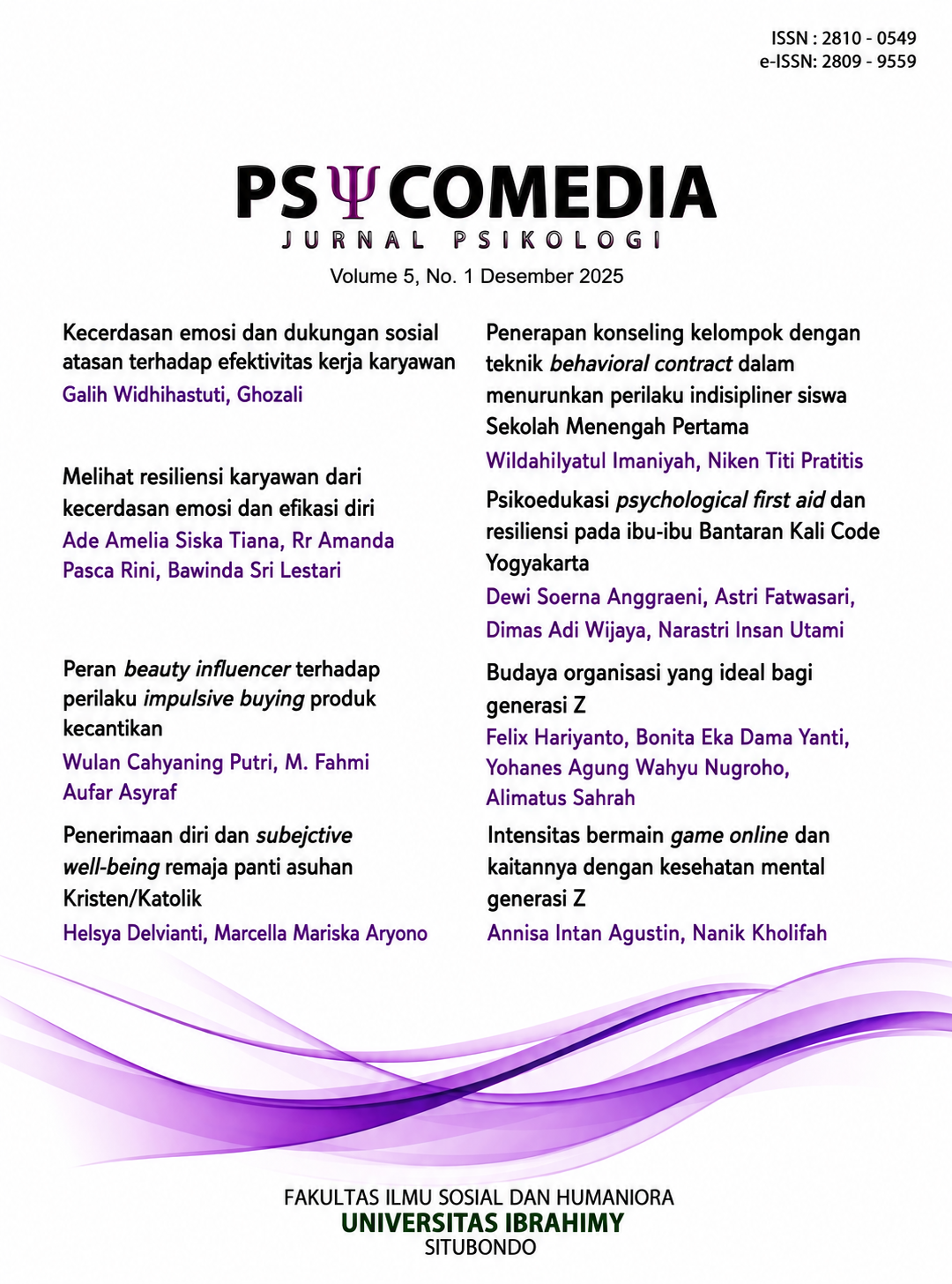
Kecerdasan emosi dan dukungan atasan terhadap efektivitas kerja karyawan
DOI:
https://doi.org/10.35316/psycomedia.2025.v5i1.1-10Keywords:
Emotional Inteligence, Supervisor Support, Work EffectivenessAbstract
Work effectiveness problems are commonly experienced by organizations and are influenced by psychological and external factors. PT X, as a manufacturing company, has experienced a decline in productivity as indicated by an increase in work errors and delays in task completion, reflecting problems in employee work effectiveness. This study aims to examine the effect of emotional intelligence and supervisor support on employee work effectiveness at PT X. This study employed a quantitative method with an associative design. The research subjects consisted of all 63 employees of PT X in Cikarang, selected using a total sampling technique. The research instrument was a questionnaire, and the data were analyzed using multiple linear regression. The results show that emotional intelligence and supervisor support have a positive and significant effect on employee work effectiveness, both partially and simultaneously. These findings indicate that employee work effectiveness can be improved through effective emotional management and optimal supervisor support. Therefore, companies are encouraged to develop emotional intelligence training programs and strengthen supportive leadership practices to enhance employee work effectiveness
References
Adelia, K. D., Zahro, Y. I., & Fitriani, A. Q. Z. (2025). Dinamika implementasi kinerja karyawan dan produktivitas kerja yang tidak tercapai:(Kebun Renteng Banjar Sari PTPN 1). Jurnal Manajemen Dakwah Dan Ilmu Komunikasi, 1(4), 203–216.
Crain, T. L., & Stevens, S. C. (2018). Family‐supportive supervisor behaviors: A review and recommendations for research and practice. Journal of Organizational Behavior, 39(7), 869–888. https://doi.org/10.1002/job.2320
Darmawan, D., & Putra, A. R. (2022). Pencapaian efektivitas kerja melalui optimalisasi kecerdasan emosional dan pemberian beban kerja secara tepat kepada karyawan. Jurnal Baruna Horizon, 5(1), 8–16. https://doi.org/10.52310/jbhorizon.v5i1.72
Dieppe, A. (Ed.). (2021). Global productivity: Trends, drivers and policies. World Bank.
Eisenberger, R., Huntington, R., Hutchison, S., & Sowa, D. (1986). Perceived organizational support. Journal of Applied Psychology, 71(3), 500–507. https://doi.org/10.1037/0021-9010.71.3.500
Fadhil, K., & Khusnia, M. (2021). Manajemen sumber daya manusia (produktivitas kerja). GUEPEDIA.
Faliza, N. (2025). MSDM di sektor manufaktur: Transformasi digital & infrastruktur. Samudera Literasi Bangsa.
Fan, C., Ye, C., Zhang, L., & Gong, Y. (2023). The impact of family supportive supervisor behavior on employees’ proactive behavior: A cognitive and affective integration perspective. Sustainability, 15(17), 1–19. https://doi.org/10.3390/su151712739
Gibson, J. L., Ivancevich, J. M., Donnely, Jr, J. H., & Konopaske, R. (2012). Organizations: Behavior, Structure, Processes (Fourteenth Edition). McGraw-Hill.
Goleman, D. (2024). Kecerdasan Emosional. Gramedia Pustaka Utama.
Gong, Z., Chen, Y., & Wang, Y. (2019). The influence of emotional intelligence on job burnout and job performance: Mediating effect of psychological capital. Frontiers in Psychology, 10, 1–11.
House, J. S., & Kahn, R. L. (1985). Measures and concepts of social support. In S. Cohen & S. L. Syme (Eds.), Social support and health (pp. 83–108). Academic Press.
Kusuma, N. T., Wiyono, G., & Lukitaningsih, A. (2020). Faktor-faktor yang mempengaruhi organizational citizenship behavior pada karyawan swasta di Provinsi Yogyakarta. Jurnal Bingkai Ekonomi (JBE), 5(1), 43–60. https://doi.org/10.54066/jbe.v5i1.65
Naseem, K. (2017). Job stress and employee creativity: The mediating role of emotional intelligence. International Journal of Management Excellence, 9(2), 1050–1058. https://doi.org/10.17722/ijme.v9i2.911
Prasetyani, I. W., & Desiana, P. M. (2022). Mediasi psychological capital dan work engagement terhadap pengaruh kecerdasan emosional pada kinerja Pegawai Negeri Sipil. Publikauma: Jurnal Administrasi Publik Universitas Medan Area, 10(2), 144–154. https://doi.org/10.31289/publika.v10i2.8212
Robbins, S. P., & Judge, T. (2015). Organizational Behavior (Sixteenth Edition). Pearson.
Saidah, S., Simatupang, M., & Greata, H. (2023). Pengaruh dukungan atasan terhadap turnover intention pada karyawan PT Sumber Alfaria Trijaya Cabang Karawang Timur. Empowerment: Jurnal Mahasiswa Psikologi Universitas Buana Perjuangan Karawang, 3(3), 34–39. https://doi.org/10.36805/empowerment.v3i3.1042
Salovey, P., & Mayer, J. D. (1990). Emotional Intelligence. Imagination, Cognition and Personality, 9(3), 185–211. https://doi.org/10.2190/DUGG-P24E-52WK-6CDG
Tucker, M. K., Jimmieson, N. L., & Bordia, P. (2018). Supervisor support as a double-edged sword: Supervisor emotion management accounts for the buffering and reverse-buffering effects of supervisor support. International Journal of Stress Management, 25(1), 14–34. https://doi.org/10.1037/str0000046
Downloads
Published
How to Cite
Issue
Section
License
Copyright (c) 2025 Galih Widhihastuti, Ghozali Ghozali

This work is licensed under a Creative Commons Attribution-NonCommercial-ShareAlike 4.0 International License.