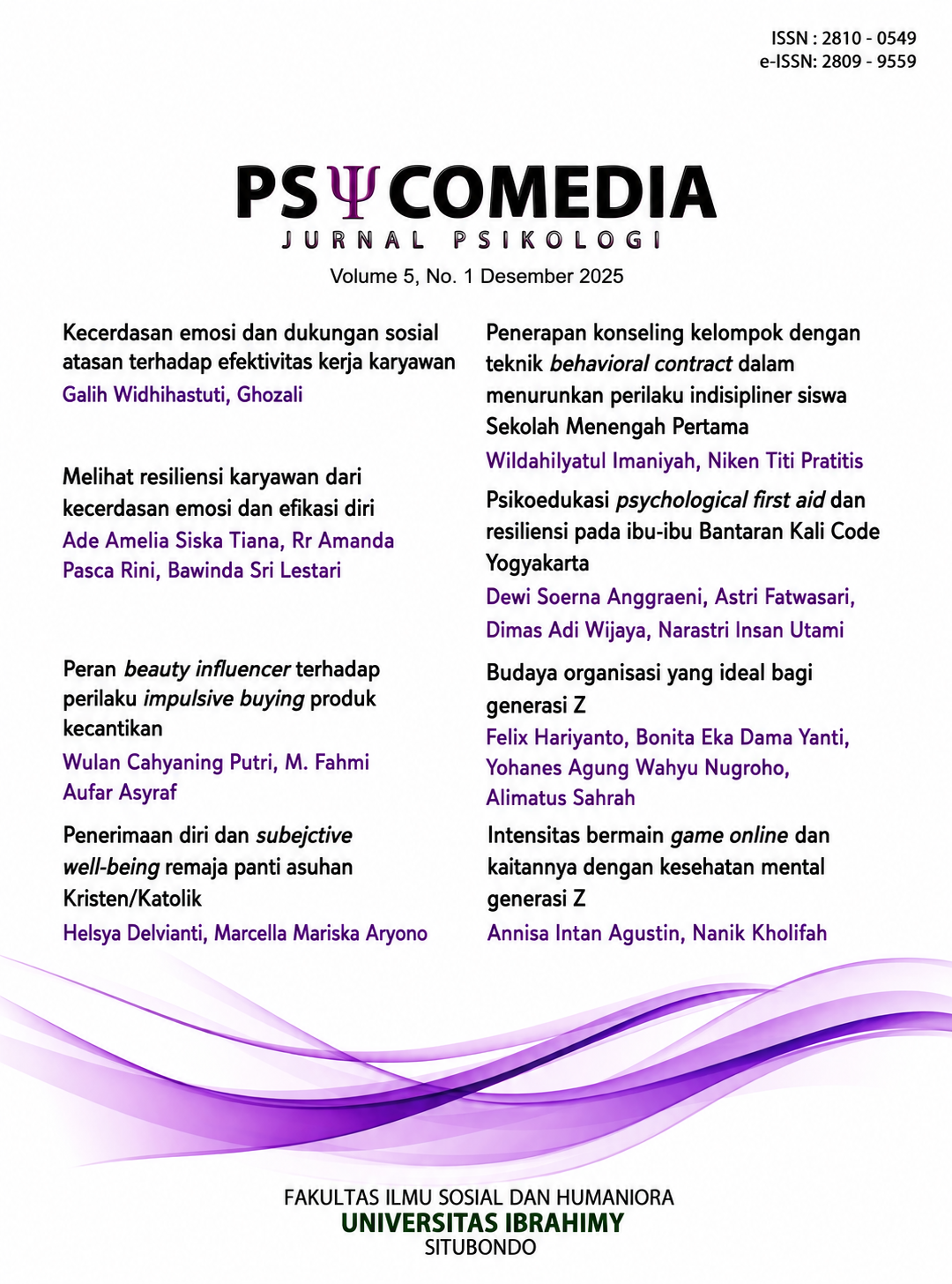
Intensitas bermain game online dan kaitannya dengan kesehatan mental Generasi Z
DOI:
https://doi.org/10.35316/psycomedia.2025.v5i1.84-92Keywords:
Mental Health, Online Games, Z GenerationAbstract
In recent years, there has been a significant increase in interest in mental health, especially among Generation Z, who have grown up in the digital age. Many members of Generation Z spend time playing online games. However, online game addiction can worsen their mental health. The purpose of this study was to investigate the impact of online game intensity on the mental health of Generation Z. A sample of 628 Generation Z students and 234 students of SMKN Tutur participated in this study using a quantitative approach with cluster random sampling. Data were collected using the Online Game Intensity Scale and the Mental Health Rating Scale, and the data were analyzed using simple linear regression analysis. The results showed a significant relationship between online game intensity and mental health problems. Thus, the hypothesis that online game intensity affects the mental health of Generation Z was accepted.
References
Ajzen, I. (2005). Attitudes, personality and behaviour. McGraw-Hill Education.
Alrahili, N., Alreefi, M., Alkhonain, I. M., Aldakhilallah, M., Alothaim, J., Alzahrani, A., Alshargi, A., & Baabbad, N. (2023). The prevalence of video game addiction and its relation to anxiety, depression, and attention deficit hyperactivity disorder (ADHD) in children and adolescents in Saudi Arabia: A cross-sectional study. Cureus, 15(8), 1–12.
Bethune, S. (2019, January 1). Gen Z more likely to report mental health concerns. Monitor on Psychology, 50(1). https://www.apa.org/monitor/2019/01/gen-z
Faizal, S. N. Z., Ulfa, N. S., & Naryoso, A. (2024). Pengaruh intensitas peer group communication dan pengendalian diri terhadap tingkat kecanduan game online mobile legends: Bang bang di kalangan generasi Z. Interaksi Online, 12(4), 899–910.
Gofar, M. (2023). Dampak game online terhadap kesehatan mental generasi Z. Islamic Studies Across Different Perspective: Trends Challenges and Inovations, 19, 640–648.
Haniyah, F. N., Novita, A., & Ruliani, S. N. (2022). Hubungan antara pola asuh orangtua, teman sebaya, lingkungan tempat tinggal dan sosial ekonomi dengan kesehatan mental remaja. Open Access Jakarta Journal of Health Sciences, 1(7), 242–250. https://doi.org/10.53801/oajjhs.v1i7.51
Harmony Health Care IT. (2025). State of gen Z mental health. Harmony Health Care IT.
Keyes, C. L. M. (2002). The mental health continuum: From languishing to flourishing in life. Journal of Health and Social Behavior, 43(2), 207–222. https://doi.org/10.2307/3090197
Khobir, S. A. (2023). Kesehatan mental remaja pecandu game online perspektif imam Al-Ghazali: Studi kasus di Area Cafe Desa Semen, Kecamatan Semen, Kabupaten Kediri [Undergraduate Thesis, Institut Agama Islam Negeri Kediri]. https://etheses.iainkediri.ac.id/11914/
Kibtyah, M., Naqiya, C., Niswah, Z., & Dewi, S. P. R. (2023). Dampak kecanduan game online terhadap kesehatan mental remaja dan penanganannya dalam konseling islam. Counseling As Syamil: Jurnal Ilmiah Bimbingan Konseling Islam, 3(1), 25–38. https://doi.org/10.24260/as-syamil.v3i1.1130
Laka, L. (2023). Metodologi penelitian dengan pendekatan kuantitatif (Jilid 2). Deepublish.
Lusiana, V. (2023). Pengaruh kecanduan game online terhadap kesehatan mental siswa SMAI NFBS Lembang. HEALTHY: Jurnal Inovasi Riset Ilmu Kesehatan, 2(1), 29–41.
Mahendika, D., & Sijabat, S. G. (2023). Pengaruh dukungan sosial, strategi coping, resiliensi, dan harga diri terhadap kesejahteraan psikologis siswa SMA di Kota Sukabumi. Jurnal Psikologi dan Konseling West Science, 1(2), 76–89. https://doi.org/10.58812/jpkws.v1i02.261
Mahmud, K. (2020). Pengaruh game online terhadap kesehatan mental mahasiswa IAIN Padangsidimpuan di Lingkungan I Kelurahan Sihitang [Undergraduate Thesis, IAIN Padangsidimpuan]. https://etd.uinsyahada.ac.id/6521/
Naluri. (2024). Kondisi kesehatan mental di asia 2024: Gen Z berisiko paling tinggi. https://www.naluri.life/id/news/2024-mental-health-asia-gen-z-most-at-risk
Nurwanti, L. A., Susanti, L. R., Tohir, O. J., Frasatya, A., & Lestari, S. (2023). Kesehatan mental pada remaja di era gempuran game online. Journal of Economics, Business, Management, Accounting and Social Sciences, 1(3), 115–118. https://doi.org/10.63200/jebmass.v1i3.30
Putri, M. Y., Yuliana, Y., Yulastri, A., Erianti, Z., & Izzara, W. A. (2023). Artikel review: Dampak kecanduan bermain game terhadap kesehatan mental. Jurnal Psikologi dan Konseling West Science, 1(5), 291–303. https://doi.org/10.58812/jpkws.v1i05.827
Vadlin, S., Åslund, C., Hellström, C., & Nilsson, K. W. (2016). Associations between problematic gaming and psychiatric symptoms among adolescents in two samples. Addictive Behaviors, 61, 8–15. https://doi.org/10.1016/j.addbeh.2016.05.001
Walton Family Foundation. (2023). Voices of gen Z: Perspective on US education, wellbeing and the future. https://nextgeninsight.wpenginepowered.com/wp-content/uploads/2024/05/walton-gallup-voices-of-gen-z.pdf
World Health Organization. (2025). Mental health. World Health Organization. https://www.who.int/news-room/fact-sheets/detail/mental-health-strengthening-our-response
Zabrina, H. K., & Palupi, L. S. (2023). The relationship between online game addiction and depression tendencies in Indonesian adolescents: Online game addiction and depression tendencies. Indonesian Journal of Health Sciences Research and Development, 5(1), 101–105. https://doi.org/10.36566/ijhsrd/Vol5.Iss1/154
Downloads
Published
How to Cite
Issue
Section
License
Copyright (c) 2025 Annisa Intan Agustin, Nanik Kholifah

This work is licensed under a Creative Commons Attribution-NonCommercial-ShareAlike 4.0 International License.