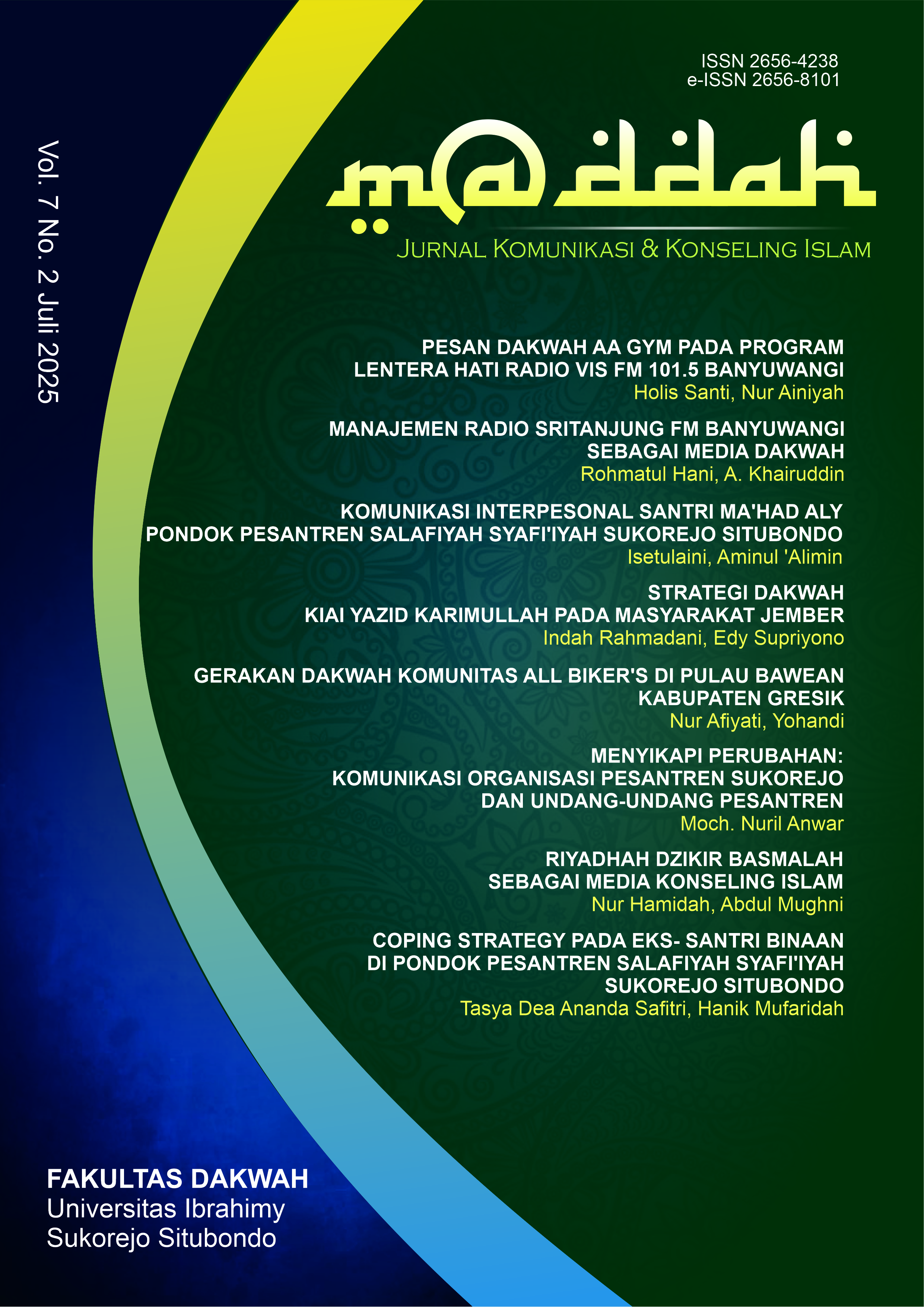
KOMUNIKASI INTERPESONAL SANTRI MA’HAD ALY PONDOK PESANTREN SALAFIYAH SYAFI’IYAH SUKOREJO SITUBONDO ISETULAINI
DOI:
https://doi.org/10.35316/maddah.v7i2.7854Keywords:
Interpersonal Communication, Students of Ma'had Aly PutriAbstract
The purpose of this study is to describe the forms of interpersonal communication of Ma'had Aly
Putri students of the Salafiyah Syafi'iyah Islamic Boarding School in Sukorejo. The Salafiyah
Syafi'iyah Islamic Boarding School in Sukorejo, Situbondo, was founded in 1914 by K.H.R. Syamsul
Arifin and his son, K.H.R. As'ad Syamsul Arifin. There are 7,000 female students who carry out
communication activities every day. Various forms or patterns of communication interactions are
established among students, one of which is interpersonal communication. This interpersonal
communication is interesting, because it has great potential to influence or persuade others. This
research uses a qualitative, descriptive approach. Descriptive research is a research strategy that
investigates events and phenomena in the lives of individuals and asks one or a group of individuals
to describe their lives. This information is then retrieved by the researcher in a descriptive chronology.
Data were obtained through observation, documentation, and interviews with students, Islamic
boarding school administrators, and stakeholders. The conclusion of this study is that interpersonal
communication between students at the Salafiyah Syafi’iya Sukorejo Situbondo Islamic Boarding School can be grouped into 2 forms. First, dyadic communication includes students with students
during muroja’ah in the musholla, old students with new students: when they are confiding, students
with administrators: when students have problems. Second, small group communication includes
students with students when joking in the room and chatting in the bathroom. Students with the room
leader during recitation in the room and during meetings in the room as well as students with the
leaders during learning, and students with teachers during learning.
References
Al-Kholile, Ismail, (2004). Kompas
Kehidupan cet III (Februari 2023), 42.
Canggara, Hafied. Pengantar Ilmu
Komunikasi. Jakarta: PT. Raja
Grafindo Persada.
Canggara, Hafied, (2004). Pengantar Ilmu
Komunikasi. Jakarta: PT. Raja
Grafindo Persada. -------dan Nafisyah, Durrotin. Pola
Komunikasi Interpersonal Santri
Dalam Menjaga Solidaritas Salafiyah
Syafi’iyah Sukorej, .Meddah, Vol. 18,
No. 2, Juli, 2021. -------dan Yani Turhan, Muhammad, (2005).
Pelanggaran Santri Terhadap
Peraturan Tata Tertib Pondok
Pesantren Tarbiyatut Tholabah
Kranji Lamongan. Jurnal Kajian Moral
dan Kewarganegaraan, Vol 02 Nomer
03 Tahun 2015, 1740-753, Surabaya:
Fakultas Ilmu Sosial, Uniersitas Negeri
Surabaayaa, 2015. 743.Yasmadi,
Modernisai Pesantren, Ciputat: PT
Ciputat Press. -------dan Yani Turhan, Muhammad.
Pelanggaran Santri Terhadap
Peraturan Tata Tertib Pondok
Pesantren Tarbiyatut Tholabah
Kranji Lamongan, Jurnal Kajian Moral
dan Kewarganegaraan, Vol 02 Nomer
03 Tahun 2015, 1740-753, Surabaya:
Fakultas Ilmu Sosial, Universitas
Negeri Surabaayaa, 2015.
Devito, A Joseph, (2010). Komunikasi Antar
Manusia. Tanggerang: Kharisma
Publishing Group.
Hadjana, M Agus, (2007). Komunikasi
Interpersonal dan Itrapersonal.
Yogyakarta: Kanisus,.
Leksono, Adi Aris. Revitalisasi Karakter
Santri di Era Milenial. Dalam
https://dki.kemenag.go.id di akses
tanggal 21 Oktober 2018.
Mastuhu, Dinamika Sistem Pendidikan
Pesantren. Jakarta: INIS, 1994.
Mulyana, Deddy, (2009) Ilmu Komunikasi
Suatu Pengantar. Bandung: PT Remaja
Rosdakarya.
Ngalimun, (2022). Komunikasi Interpersonal.
Yogyakarta: Pustaka Belajar. -------Nihwan Muhammad. Tripologi
Pesantren (Mengkaji Sistem Salaf dan
Modern).
Muhammadnihwan86@gmail.com
pasiun86@gmail.com. JPIK Vol. 2 No.
1, Maret 2019:59-81.
Subur, Alex, (2004). Semiotika Komunikasi.
PT Remaja Rosdakarya: Bandung.
Supratiknya, (2009). Tinjauan Psikologis
Komunikasi Antarpribadi. Yogyakarta:
Kanisius.
W.A, Suranto, (2010). Komunikasi
Interpersonal. Yogyakarta: Graha
Ilmu.
Wiryanto, (2004). Pengantar Ilmu
Komunikasi. Jakarta: Grasindo.