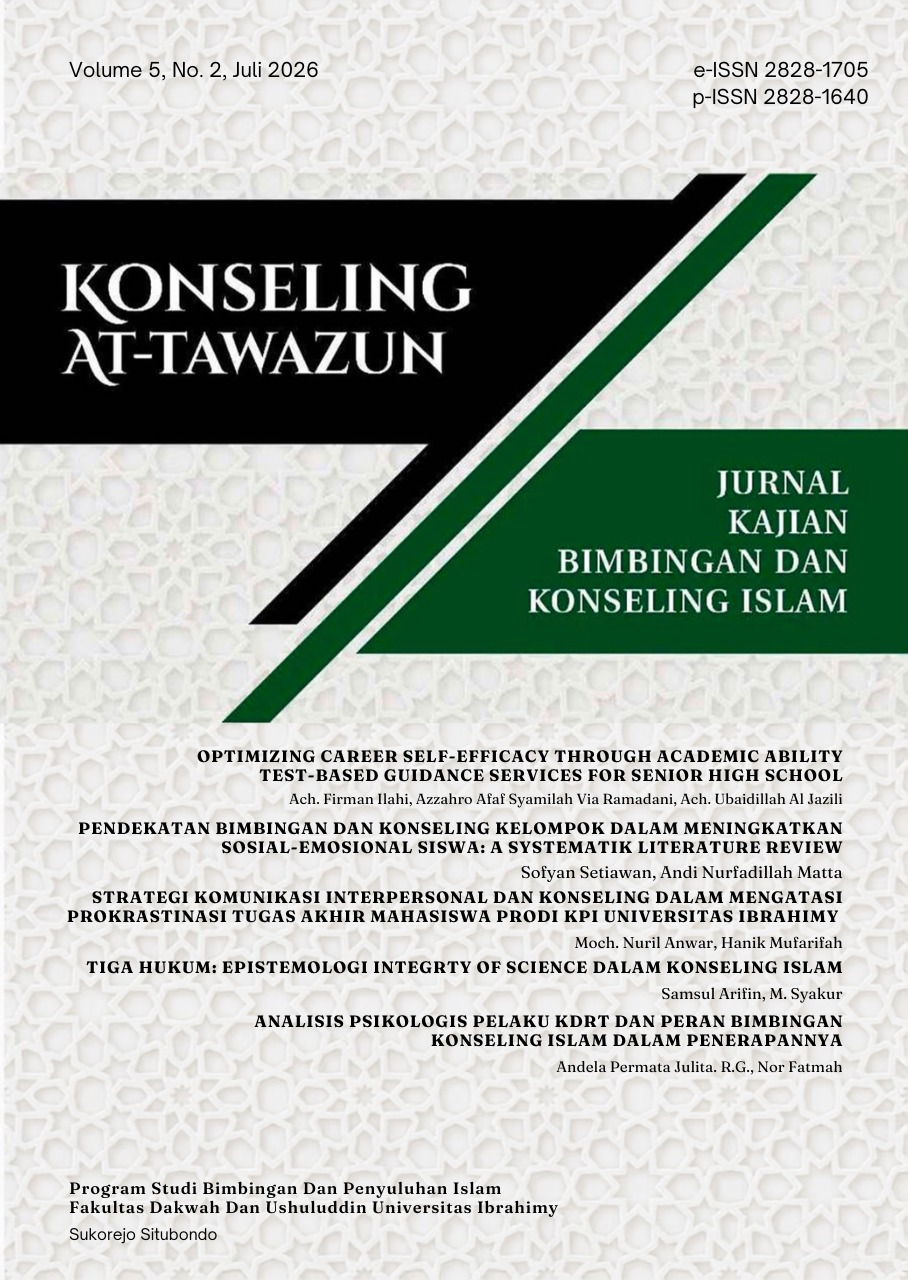
TIGA HUKUM, SATU ILMU: EPISTEMOLOGI INTEGRITY OF SCIENCE DALAM KONSELING ISLAM
DOI:
https://doi.org/10.35316/attawazun.v5i2.10104Keywords:
epistemologi, integrity of science, konseling islamAbstract
This article proposes an epistemological framework for the development of Islamic Guidance and Counseling as a discipline situated at the intersection of modern counseling psychology and Islamic scholarly traditions. The central argument is that the integrity of science in Islamic counseling cannot be achieved through the mastery of a single method whether Western clinical techniques or literal adherence to religious texts but rather through a balanced proportionality among six sources of knowledge: revelation, reason, the senses, intuition, empirical experience, and scientific tradition. To operationalize this framework, the article examines two epistemic models derived from the body of thought of K.H.R. As'ad Syamsul Arifin, the leader of the Salafiyah Syafi'iyah Sukorejo Islamic Boarding School: the taxonomy of three categories of judgment (aqli, shar'i, and 'adat), explicitly formulated as a pedagogical prerequisite in Risālah al-Tauḥīd (Arifin, 1973a); and a broader epistemic architecture encompassing spiritual, axiological, anthropological, and methodological dimensions traceable through his entire body of work and leadership practices. The study employs a qualitative-interpretive approach with a thematic analysis strategy applied to three layers of data: twelve primary written works, three biographies, and two collections of his teachings. The findings indicate that the taxonomy of three categories of judgment is not merely a doctrinal legacy of Ash'ari theology associated with the figure in question, but rather an epistemic structure consistently operationalized across various fields of knowledge and even explicitly utilized as a diagnostic criterion for assessing the validity of spiritual authority. The article argues that this type of proportionality offers an alternative to the methodological monism that restricts cross cultural counseling debates to a binary choice between clinical science and literal faith, while simultaneously providing a more explicit epistemic foundation for pesantren based counseling models such as at-tawazun (Arifin, 2012, 2020). The practical implication is the need for Islamic counseling practitioners to develop epistemic sensitivity regarding how religious clients classify their problems based on the sources of knowledge they deem relevant.
Downloads
Published
How to Cite
Issue
Section
License
Copyright (c) 2026 Samsul Arifin, M. Syakur

This work is licensed under a Creative Commons Attribution 4.0 International License.