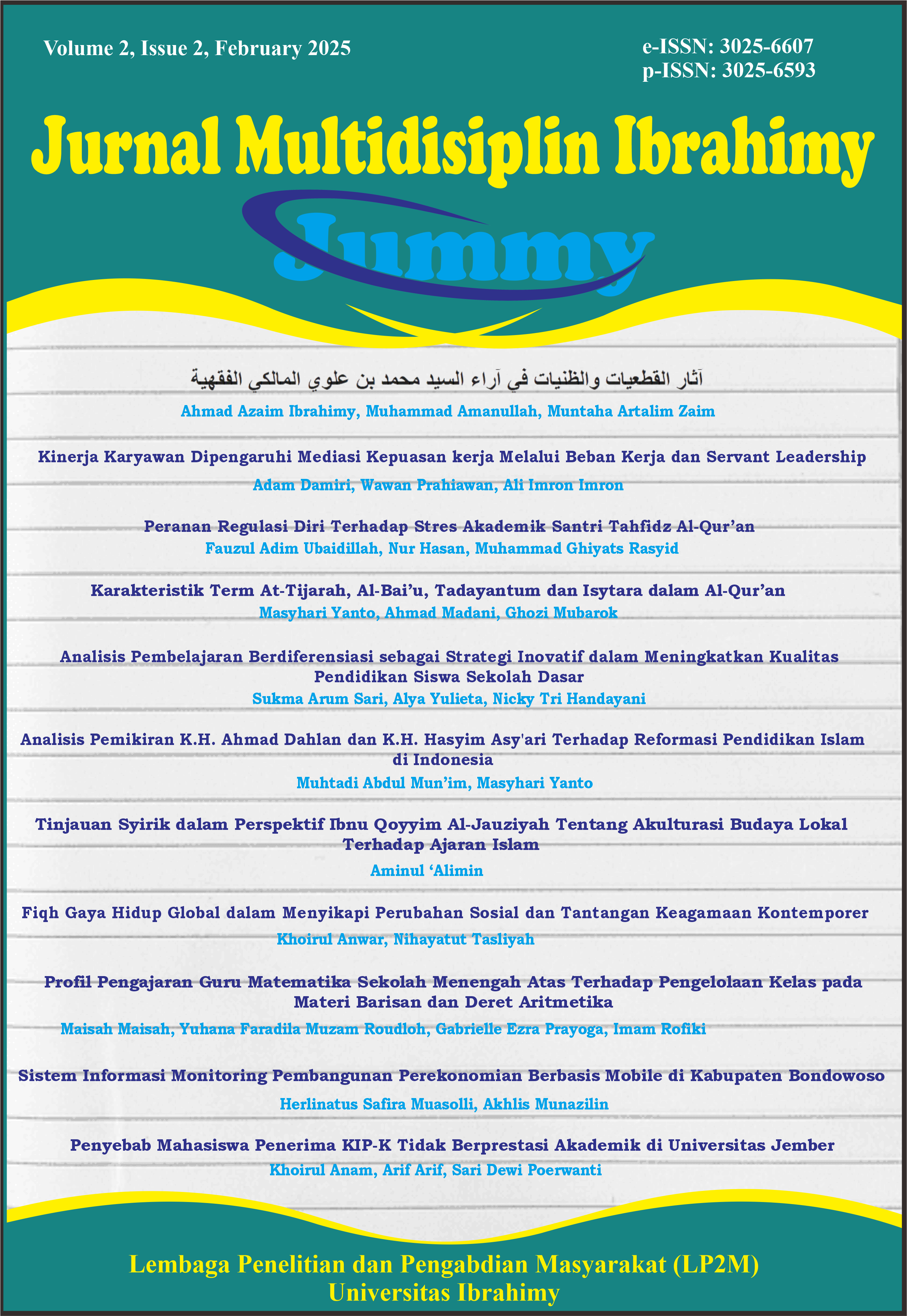
Fiqh Gaya Hidup Global dalam Menyikapi Perubahan Sosial dan Tantangan Keagamaan Kontemporer
DOI:
https://doi.org/10.35316/jummy.v2i2.6799Keywords:
Contemporary, Fiqh, Global Lifestyle, Social Change, Religious ChallengesAbstract
Globalization has become the ruler of the world that is ready to penetrate the public massively, both positively and negatively. The flow of globalization continues to flow to all corners of society by breaking down the boundaries of space and time. Whoever can control the global, then he will be the champion. Including in terms of lifestyle, such as fashion. For Muslims, through fiqh has claimed to be able to regulate all aspects of human behavior, let alone just fashion matters, Various schools of thought review their explanations at length. However, the global situation has divided three types of thinking, namely anti-modernity, influenced by modernity, and critical. Fiqh has formulated the concept of aurat as something that is principle or dharury, and basic (hajiyah) and provides a gap to complement the aspect of beauty or tahsiniy. Even so, the appearance in public space by showing the aspect of beauty or tahsiny actually contains a contestation between religion and global ideas, namely in terms of formulating fashion criteria, the struggle for artistic and religious identities, standardization of Islamic fashion, and hegemony. Through the choice of rationality, Muslims are free to outwit religion and follow market tastes.
References
Abdullah, Irwan. Konstruksi dan Reproduksi Kebudayaan. Yoyakarta: Pustaka Pelajar, 2010.
Abdullah, Irwan, dkk, (ed). Dinamika Masyarakat dan Kebudayaan Kontemporer, Yogyakarta: Pustaka Pelajar, 2009.
Abu Zahra, Muhammad, tt. Ushul Fiqh. Beirut: Dar al-Fikr.
Dhafir, Zamahsari, Tradisi Pesantren. Jakarta: LP3ES, 1994.
Featherstone, Mike. Posmodernisme dan Budaya Konsumen.tarjamah Misbah Zulfa Elizabeth. Yogyakarta: Pustaka Pelajar, 2008.
Ibnu, Katsir. Tafsir al-Qur’an al-Adhim. Beirut: Dar al-Ihya al-Turats, 1995.
Jeknis, Richard. Membaca Pikiran Bourdieu. tarjemah. Nur hadi. Bantul: Kreasi Wacana, 2010.
Khallaf, Abdul Wahhab, Ilmu Ushul Fiqh. Kuwait: Dar al-Qalam, 1978.
M. Dawam Raharjo (Ed.). Pesantren dan Pembaharuaan. Jakarta: LP3ES, 1988.
Mastuhu. Dinamikaa Sistem Pendidikaan Pesantren.Jakarta: INIS, 1994.
Al-Nawawi, Abu Zakariya, Muhyiddin bin Syaraf, tt. al-Majmu’. Beirut: Dar al-Fikir
Al-Naisaburi, Abu Husain Muslim Ibnu al-Hijaj al-Qusyairi, tt. Shahih Musli.,Beirut: Dar al-Fikr
Patria, Nezar dan Arief, Andi. Antonio Gramci Negara & Hegemoni.Yogyakarta: Pustaka Pelajar, 2003.
Qadri Azizy, A., Melawan Globalisasi; Reinterpretasi Ajaran Islam Persiapan SDM dan Terciptanya Masyarakat Madani. Yogyakarta: Pustaka Pelajar, 2004.
Al-Razi, Fakhruddin Muhammad bin Umar. Tafsir al-Kabir. Beirut: Dar al-Kutub, 1990.
Ritzer, George dan J.Goodman, Douglas. Teori Sosiologi Modern. Jakarta: Kencana Prenada Media Group, 2007.
Al-Sajistani, Abu Dawud Sulaiman bin As’ats, Sunan Abu Dawud. Beirut: Dar al-Ilmiyah, 1993.
Shihab, M. Quraish. Membumikan al-Quran. Jakarta: Mizan, 2000.
,Sujarwa. Mitos Dibalik Kisah-Kisah Sinetron dalam perspektif Hegemoni dan Kapitalisasi.Yogyakarta: Pustaka Pelajar, 2010.
W. Jorgensen, Marianne dan J. Philips Louise. Analisis Wacana Teori dan Metode. Tarjemah Imam Suyitno, dkk. Yogyakarta: Pustaka Pelajar, 2007
Downloads
Published
How to Cite
Issue
Section
License
Copyright (c) 2025 Khoirul Anwar, Nihayatut Tasliyah

This work is licensed under a Creative Commons Attribution-ShareAlike 4.0 International License.








_by_Matematohir.jpg)