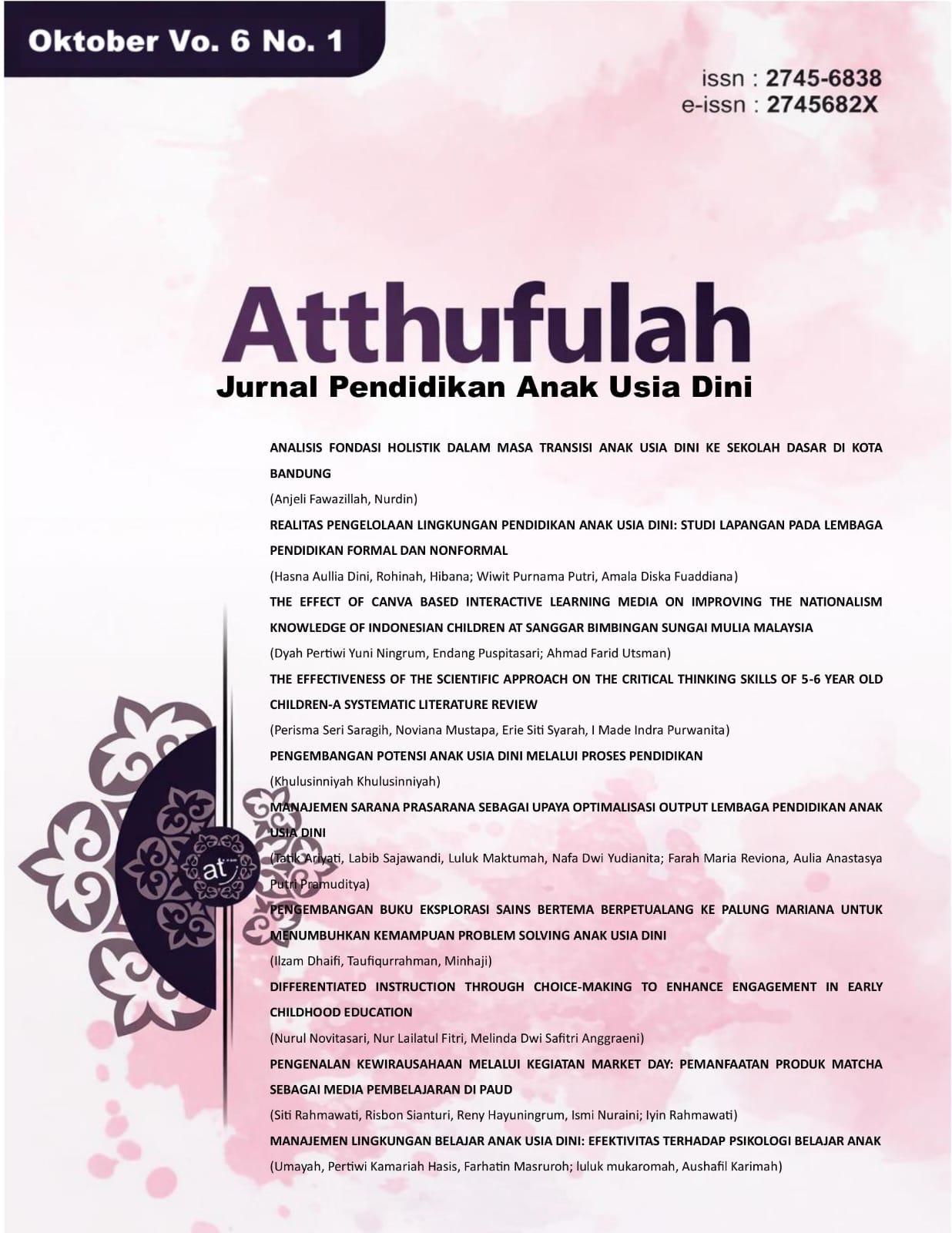
THE EFFECTIVENESS OF THE SCIENTIFIC APPROACH ON THE CRITICAL THINKING SKILLS OF 5-6 YEAR OLD CHILDREN-A SYSTEMATIC LITERATURE REVIEW
Keywords:
Scientific Approach, Critical Thinking, Early ChildhoodAbstract
Critical thinking skills are essential skills that need to be developed from an early age to face the challenges of the 21st century. This study aims to assess the effectiveness of the scientific approach in improving the critical thinking skills of children aged 5-6 years through a systematic literature review. Data were collected from ten selected scientific articles published between 2020 and 2025 and analyzed based on strict inclusion and exclusion criteria. The study results show that the scientific approach significantly improves children's critical thinking skills, especially in the aspects of observing, questioning, reasoning, problem solving and concluding. This approach is effectively applied in various learning contexts, including conventional learning as well as those that integrate technology and innovative methods such as mind mapping, makerspace and problem-based learning. Successful implementation is strongly influenced by teacher competence, learning environment support, and parental involvement. However, challenges such as limited teacher understanding, lack of resources and low parental participation are still obstacles. Although its short-term effectiveness has been proven, longitudinal research is needed to assess its long-term impact on children's cognitive development. Thus, the scientific approach is recommended as the main learning strategy in early childhood education to optimally build the foundation of critical thinking.
References
Alucyana, A., & Raihana, R. (2023). Scientific learning in developing critical thinking and problem solving skills in children. Journal of Obsession: Journal of Early Childhood Education, 7(1),829-841.https://doi.org/10.31004/obsesi.v7i1.4096:contentReference[oaicite:11]{index=11}
O'Reilly, C., Devitt, A., & Hayes, N. (2022). Critical thinking in the preschool classroom - A systematic literature review. Thinking Skills and Creativity, 46. https://doi.org/10.1016/j.tsc.2022.101110
Ni Luh Ardia P R Cahyani, B. T., Prima, E., Endah Poerwati, C., Early Age, A., Critical, B., & Scientific, P. (2024). Implementation of a Scientific Approach to the Critical Thinking Ability of Group K1 B Children at Taman Rama Jimbaran Kindergarten. 3(1). https://jurnal.undhirabali.ac.id/index.php/jakadara/index
Zevender, P. S., Disman, D., Mulyadi, H., Mardetini, E., Adriani, D., & Hakam, L. I. (2024). Learning model development moodle-based problem-based learning to improve critical thinking ability. JPPI (Journal of Indonesian Education Research), 10(3), 693.
https://doi.org/10.29210/020242982
Özkan Kunduracı, H. K., Yaralı, K. T., & Kaynak, S. (2024). Measuring parental behaviors supporting higher order thinking skills in children: A scale development study. Thinking Skills and Creativity, 54. https://doi.org/10.1016/j.tsc.2024.101685
Polat, Ö., & Aydın, E. (2020a). The effect of mind mapping on young children's critical thinking skills. Thinking Skills and Creativity, 38.https://doi.org/10.1016/j.tsc.2020.100743
Yang, W., Liang, L., Xiang, S., & Yeter, I. H. (2025). Making a Makerspace in early childhood education: Effects on children's STEM thinking skills and emotional development. Thinking Skills and Creativity, 56. https://doi.org/10.1016/j.tsc.2025.101754
Nugroho, A., Hadi, S., & Lestari, D. (2020). Scientific approach in early childhood education to foster critical thinking skills. Journal of Early Childhood Education Research, 9(1), 45-56. https://doi.org/10.1234/jece.v9i1.2020
Sari, T., & Widodo, H. (2022). Teacher strategies in developing children's critical thinking skills through a scientific approach. Journal of Early Childhood Education, 6(2), 120-130. https://doi.org/10.21009/jpaud.062.07
Downloads
Published
How to Cite
Issue
Section
License
Copyright (c) 2025 Perisma Seri Saragih, Noviana Mustapa, Erie Siti Syarah, I Made Indra Purwanita

This work is licensed under a Creative Commons Attribution-ShareAlike 4.0 International License.










_by_Matematohir.jpg)